🎶 “Empower Yourself” (Live Version) by Sakshi Zion & The Tuff Tones
This song is a celebration of self-empowerment, personal responsibility, and awakening to the light within.
Inspired by a familiar biblical parable and woven together with an uplifting roots reggae groove, hints of dub, and heartfelt original lyrics, Empower Yourself is an invitation to stand in your truth, embrace your purpose, and remember the power you’ve been given.
The song builds into a blessing-filled bridge and closing chant:
✨ “Truth and Right… Love and Light…” ✨
My hope is that these words stay with you long after the music ends and encourage you to move through life with courage, compassion, and confidence.
I’d be honored if you’d take a few minutes to listen, share it with a friend, and add it to your favorite playlist.
If the song resonates with you, sharing it on social media, adding it to a playlist, or sending it to someone who could use a little encouragement is one of the greatest ways you can support independent music.
Thank you for being part of this journey and for allowing my music to be a small part of your life.
There are biographies that simply tell a life story, and then there are biographies that attempt to translate an atmosphere of devotion, presence, and spiritual impact into language. Ammachi — A Biography of Mata Amritanandamayi belongs to the second category. It is not only about documenting the life of Mata Amritanandamayi, but about trying to make sense of how one person came to be regarded by millions as a living embodiment of unconditional love.
At its core, the book traces Amma’s journey from her humble beginnings in a fishing village in Kerala, India, to becoming an internationally recognized spiritual teacher known for her embrace—literally her practice of hugging devotees as a form of darshan and healing presence. What begins as a local, culturally rooted life gradually expands into a global movement centered around service, compassion, and humanitarian work.
Ammachi : A Biography of Mata Amritanandamayi by Swami Amritaswarupananda
Ammachi — A Biography of Mata Amritanandamayi offers an in-depth look at the life and spiritual mission of Mata Amritanandamayi, one of the most widely recognized contemporary spiritual figures in the world. Known as “Amma” or the “Hugging Saint,” she is celebrated for her practice of offering embraces as a form of darshan and unconditional love. This biography explores her early life in Kerala, her emergence as a spiritual teacher, and her global humanitarian initiatives, including disaster relief, education, healthcare, and housing projects. The book highlights her core teaching that true spirituality is expressed through selfless service (seva) and compassion in action. For readers interested in Hindu devotional traditions, modern spiritual movements, and living embodiments of compassion, Amma’s story stands as a powerful example of love translated into action on a global scale.
A Life Framed as Living Devotion
One of the most striking aspects of the biography is how it frames Amma’s early life not as a buildup toward “achievement” in the conventional sense, but as a steady unfolding of devotional consciousness. From childhood, she is portrayed as deeply sensitive to suffering, often prioritizing compassion and service over social expectations, even when this caused friction within her family and community.
The narrative presents her spiritual realization not as a sudden transformation, but as something continuous—almost as if her life never shifted from ordinary to extraordinary, but rather revealed that the extraordinary was always already present.
Amma Hug
The Practice of Embrace
The most well-known aspect of Amma’s public life is her hug—offered to anyone who comes to her, often for hours on end, sometimes for days without rest during large gatherings. The biography treats this not as a symbolic gesture alone, but as a central spiritual practice rooted in the idea that divine love is expressed through physical presence and care.
For many readers, this raises an immediate question: how can a physical act carry spiritual weight on such a massive scale? The book does not attempt to reduce the practice into metaphor. Instead, it leans into the idea that repetition, intention, and sustained compassion can themselves become a kind of transmission.
Themes of Service and Global Humanitarian Work
Beyond the personal spiritual narrative, the biography also documents Amma’s large-scale humanitarian initiatives—disaster relief, housing projects, hospitals, educational institutions, and environmental efforts. These efforts are presented as extensions of her teaching that spirituality is incomplete without service.
A recurring theme is “love in action”—the idea that inner realization must manifest outwardly in tangible care for the world. This is where the book moves beyond hagiography and into the realm of lived philosophy: spirituality measured not only in insight, but in infrastructure and sustained aid.
Ammachi
Writing Style and Perspective
The tone of the biography is generally reverent. It does not attempt to maintain strict journalistic distance, which will likely shape how readers respond to it. For devotees or those already inclined toward bhakti traditions, this style feels appropriate and immersive. For more skeptical readers, it may feel one-sided or insufficiently critical.
That tension is part of the book’s identity: it is not simply reporting on a figure, but participating in the devotional atmosphere surrounding her.
What the Book Does Well
It provides a coherent narrative of Amma’s early life and spiritual emergence
It clearly explains the development of her global humanitarian mission
It captures the emotional and devotional energy surrounding her teachings
It helps contextualize her practice within Hindu devotional traditions and modern spiritual movements
Final Reflection
Ammachi — A Biography of Mata Amritanandamayi is best approached not as a detached historical account, but as a devotional biography that attempts to transmit something of its subject’s presence through narrative. Whether one interprets Amma’s life as spiritual phenomenon, cultural movement, or humanitarian legacy, the book succeeds in conveying the scale of her influence and the emotional gravity that surrounds her work.
For readers interested in contemporary spirituality, bhakti traditions, or modern manifestations of global religious movements, this biography offers a meaningful entry point—even if it ultimately leaves interpretation open to the reader’s own discernment.
To learn more about Amma go to her official website here : Amma.org
Amma Biography
If you’re feeling called to go beyond knowledge and step into real transformation, it’s time to align your spiritual growth with financial empowerment. Join our Grow Rich Mastermind community, where conscious entrepreneurs are learning how to build abundance from the inside out.
Take the next step and explore our Turn Key Online Business Opportunity—a simple, powerful system designed to help you create income, impact lives, and embody true freedom. Tap in now and start building the life your soul already knows is possible.
Before Krishna was a king. Before he was a known as Avatar. He was a child who loved cows. 🐄💙
Butter on his hands. Dust on his feet. A flute tucked into his waist.
Krishna didn’t rule from a throne — he wandered the pastures. He knew every cow by name. He listened to their breath. He slept beside them. He protected them like family.
The cows followed him not out of fear, but out of love.
In their eyes, he wasn’t Vishnu. He wasn’t a savior. He was one of them.
This is the forgotten heart of Krishna: 🌿 God choosing village life 🌿 Power choosing tenderness 🌿 Divinity choosing care
Before temples. Before theology. Before empires.
God was a cowherd. And love was the religion.
🐄✨💙
Krishna Govinda Lover of the Cows
𓋹 𓋹 𓋹
Thanks for visiting my blog! To learn more about this Esoteric Wisdom and Gnosis, and to connect deeper with a circle of like-minded and inspired Wisdom Seekers, like you…
Click here & listen to our Daily Mastermind Call (recorded live Mon-Fri) & also I invite you to work directly with me. I’m here to help! Send me a message to discuss your interests and questions.
There are books that you open – and there are books that transport you. Aleister Crowley in India is firmly in the latter category. In this masterful work, Tobias Churton takes the often-mysterious life of Aleister Crowley and places him in a vivid, unexpected context: the Indian subcontinent and its spiritual traditions. Far from being a tangent in Crowley’s life, this segment of his journey becomes the keystone in understanding how Eastern mysticism — yoga, Vedanta, Buddhism — informed his Western magickal experiments.
Previously unseen material. Churton opens archival diaries and lesser-known records of Crowley’s time in India, Sri Lanka and Burma from 1901-1906, shedding new light on a chapter often glossed over.
A bridging of East and Occult. This isn’t merely a biographical detour — the book shows how Crowley’s immersion in jnâna-yoga, Tantric philosophy and Buddhist dhyâna deeply coloured his later magical system.
Narrative + scholarship. Churton weaves travel-ogue, spiritual odyssey and rigorous historical context — set against colonial India, early Theosophy, and the Himalayas. The journey is as captivating as the subject.
A reflection on legacy. Crowley is no mere occult celebrity here — he becomes a mirror reflecting Western fascination with Eastern wisdom, and the cultural forces that blended Buddhism, yoga and magic in the early 20th century.
Key Themes & Takeaways
Transformation through place. India isn’t just a backdrop — Crowley’s time in the Subcontinent becomes transformative, forcing him to confront spiritual practice, ascetic discipline, and the limits of Western esoteric assumptions.
The cross-pollination of traditions. The text deftly shows Crowley absorbing Vedantist, Tantric and Buddhist threads, synthesizing them within his own system of Thelema and Western ceremonial magic.
Mysticism meets mountaineering. Fun fact: Crowley’s Himalayan expeditions (e.g., K2/Kangchenjunga) intersect with his spiritual quest — Churton explores this convergence of physical and metaphysical ascension.
Inner work as outer journey. The diaries and experiences documented reveal Crowley’s struggle with malaria, big game hunting, mystic trances, and the tension between spectacle and sincere practice. The result: we witness not simply the “Great Beast” headline, but a human in search of communion.
A cautionary mirror. While rich in insight, the book also reminds us of the complexity, hubris and controversy inherent in Crowley’s figure — and invites reflection on how we engage with spiritual tradition today.
What Works — and What Might You Want to Be Aware Of
Strengths:
Rich, well-researched detail: Churton has clearly scoured archives and delivers new content even for seasoned Crowley watchers.
Engaging storytelling: The journey is vivid, with travel-scenes, mystical awakenings, and archival voices making the past feel alive.
Deep context: The book does not simply celebrate Crowley, but locates him within cultural, spiritual, colonial and esoteric frameworks.
Considerations:
Dense sections: Some chapters dive deep into yogic terminology, Hindu philosophical concepts or archival minutiae — readers unfamiliar with spiritual/esoteric vocabulary may need to slow down.
Crowley’s polarising figure: This is not a purely hagiographic biography; Crowley’s controversies, excesses and contradictions are present. If you expect a simple hero-story, you may find the nuance challenging.
Focused scope: Because the book zooms in on 1901–1906 and Eastern influence, those wanting a full Crowley biography may still want to supplement with more general works.
Aleister Crowley
Why I Recommend It
If you are interested in spiritual synthesis, the intersection of East and West, or the hidden roots of modern occultism, Aleister Crowley in India will electrify your mind. It changes the way we understand Crowley’s “Beast” persona — not as an isolated provocateur, but as a traveler in search of transcendence, a conduit between Himalayan yoga traditions and Western magical systems.
For anyone building a library on esoterica, yoga history, mysticism, or the cultural transplantation of spiritual practice, this book stands out as essential reading. I found myself scribbling notes, pausing to research yogic terms, and reflecting on how the East-West spiritual bridge remains alive today.
Get your own copy!
Ready to dive into this remarkable journey? Click the link below to purchase Aleister Crowley in India on Amazon and start exploring one of the most fascinating crossroads in spiritual history:
Don’t just read about magic — step into a story where the Himalayas, yogis, colonial India and Western occultism converge.
Whether you come for the occult intrigue, the yogic depth, or the biography of a boundary-breaking icon, Aleister Crowley in India delivers. Tobias Churton invites you on a voyage — one where the map of spiritual history expands, and where the “Great Beast 666” becomes something far more layered: seeker, ascetic, explorer, hybrid.
If you finish the final page and find your world a little wider — your questions a little deeper — then this book has done its work. I highly recommend it for anyone ready to venture beyond the familiar, into the wild meeting ground of East and Occult.
Happy reading… and may your Will truly meet your True Will.
Aleister Crowley as Hindu Monk
𓋹 𓋹 𓋹
Thanks for visiting my blog! To learn more about this Esoteric Wisdom and Gnosis, and to connect deeper with a circle of like-minded and inspired Wisdom Seekers, like you…
Click here & listen to our Daily Mastermind Call (recorded live Mon-Fri) & also I invite you to work directly with me. I’m here to help! Send me a message to discuss your interests and questions.
Throughout history, humanity has imagined cosmic forces of destruction—not merely as harbingers of doom, but as sacred agents of transformation. In the Bible, the mysterious Abaddon (Apollyon) rises as the angel of the abyss, the destroyer who ushers in the end of an age. In the ancient traditions of India, Shiva—Rudra of the Vedas—is the great dissolver of worlds, whose sacred dance shatters illusion so that new creation can unfold. Though they come from different cultures, both figures embody a profound truth: destruction is not chaos for its own sake—it is the doorway into rebirth. In this mythic poem and visual, Abaddon and Shiva meet at the edge of time, revealing what happens when the destroyers speak to one another.
Apollyon fighting with Christian from John Bunyan’s “The Pilgrims Progress”
In the Bible, Abaddon represents a place of destruction or the personification of destruction itself. The term comes from the Hebrew word ‘ăḇaddōn (אֲבַדּוֹן), which means “destruction” or “ruin.”
Here’s how it appears in different parts of Scripture:
1. Old Testament (Hebrew Bible):
Abaddon is often used as a poetic synonym for Sheol (the realm of the dead). It doesn’t refer to a specific being, but more of a realm of death and destruction.
Job 26:6 – “Sheol is naked before God, and Abaddon has no covering.”
Proverbs 15:11 – “Sheol and Abaddon lie open before the Lord…”
Here, Abaddon is a place—the deep, shadowy region of the dead.
2. New Testament (Revelation 9:11):
In this verse, Abaddon is personified as a being:
“They have as king over them the angel of the bottomless pit. His name in Hebrew is Abaddon, and in Greek he is called Apollyon [destroyer].”
Here, Abaddon is not a place but an angelic being (possibly fallen), described as the king of demonic locusts unleashed during the end times. The Greek equivalent, Apollyon, literally means “Destroyer.”
Symbolic Meaning:
Destruction or ruin
Judgment or the forces of chaos released during the end times
In some interpretations, he’s seen as a kind of satanic figure, but in others, as an angel of judgment under God’s authority
The Angel with the Key to the Bottomless Pit Artist: Albrecht Dürer (German, Nuremberg 1471–1528 Nuremberg) Date: ca. 1498
Ancient Parallels??
Could there be any parallels and ancient parallels between Abaddon, Apollyon and Lord Shiva in ancient Dravidian culture or Rudra from ancient Aryan culture as the destroyer?
Yes — there are compelling thematic parallels between Abaddon/Apollyon from Biblical and Greco-Roman sources, and Lord Shiva/Rudra from Indian (both Dravidian and Vedic) traditions. While the figures come from vastly different cultural and theological frameworks, we can find deep resonances in their roles as destroyers, liminal figures, and forces of both chaos and renewal.
Here’s a breakdown of the parallels:
1. Abaddon / Apollyon (Hebrew / Greek)
Role: Angel of the abyss (Revelation 9:11), king of destruction, associated with the end times.
Name Meaning: Abaddon = “destruction” (Hebrew), Apollyon = “destroyer” (Greek).
Function: Unleashes plagues or divine judgment; dwells in or rules over the abyss (bottomless pit).
Moral Alignment: Ambiguous — either a fallen angel or an agent of divine judgment.
2. Shiva (Hindu / Dravidian traditions)
Role: The Destroyer (part of the Hindu Trimurti — Creator, Preserver, Destroyer).
Name Meaning: Shiva = “auspicious one”, but his role is paradoxically that of destruction.
Function: Brings about the destruction that leads to transformation and renewal (cyclical cosmology).
Attributes: Meditative, ascetic, wild, dances the Tandava, the cosmic dance of creation and destruction.
3. Rudra (Vedic / Aryan tradition)
Earlier Form of Shiva: Rudra is a fierce, storm-god from the Rig Veda. Later absorbed into Shiva.
Name Meaning: “The Howler” or “The Roarer”.
Function: God of storms, wildness, healing and destruction.
Dual Nature: Terrifying and healing — he is prayed to for protection from his own wrath.
Deeper Cultural Reflection:
Abaddon and Shiva both symbolize the sacred power of destruction, but their context differs:
In Judeo-Christian thought, destruction is often linear and eschatological (leading to an end).
In Hindu thought, destruction is cyclical and regenerative (leading to rebirth).
Both figures guard or unleash great power, and both sit at the edge between the divine and the terrifying.
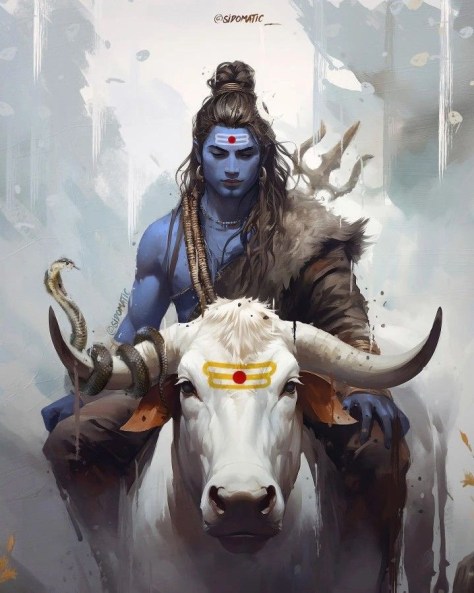
Lord Shiva
Possible Cultural Connections?
While there’s no direct historical link proven between Biblical and Indian traditions, it’s worth noting:
The ancient Near East and South Asia did have indirect cultural contact via trade and oral myths.
The “destroyer” archetype is deeply archetypal and appears across many ancient cultures:
Hades (Greek), Ereshkigal (Sumerian), Mot (Canaanite), Kali (Hindu), etc.
So while Abaddon and Shiva are not the same entity, they may both tap into a universal archetype: the fearsome, mysterious force that breaks down what must be broken, whether for judgment, purification, or transformation.
Jungian Lens: Archetypes of the Destroyer
In Carl Jung’s analytical psychology, archetypes are universal symbols or motifs embedded in the collective unconscious—shared across all human cultures. The Destroyer archetype (also called the Shadow, Death, or Transformer) shows up in myths, dreams, and religious traditions everywhere.
Abaddon/Apollyon as Archetype:
Represents the Shadow in apocalyptic form: the repressed, chaotic, dangerous aspects of the psyche that must rise during times of crisis.
He comes from the abyss, the unknown unconscious, and brings reckoning.
Often appears in times of spiritual or societal collapse — a necessary chaos before rebirth (think: Revelation, the ultimate apocalypse).
Shiva/Rudra as Archetype:
A much more integrated version of the Destroyer. He’s terrifying and sacred.
Shiva doesn’t just destroy — he dances on ignorance, illusions, and ego.
He shows how embracing the Shadow (the wild, the painful, the unknown) leads to transcendence and enlightenment.
His destruction is not punishment, but clearing the way for growth — just like winter precedes spring.
So Jung would see Abaddon as a shadow figure erupting from repression, while Shiva represents the full acceptance of the Shadow — the dark that purifies and renews.
Shiva Nataraj doing Dance of Destruction
Mythological Parallels & Cross-Cultural Themes
Let’s zoom out and look at other mythic destroyer figures. You’ll see a pattern:
Hebrew/Christian Abaddon/Apollyon Angel of destruction, ruler of abyss, divine agent of judgment
Greek Hades / Thanatos God of the underworld, not evil, but feared
Sumerian Ereshkigal Queen of the underworld, sister to Inanna, keeper of death
Canaanite Mot God of death and sterility, opponent of Baal
Egyptian Set God of chaos, storms, necessary opponent of Osiris
Aztec Tezcatlipoca Lord of sorcery, chaos, and transformation
These beings often dwell in borderlands—between life and death, order and chaos, spirit and matter. They are not evil, but dangerous. Necessary. And usually misunderstood.
Abaddon & Shiva: A Mythic Dialogue
Imagine them in dialogue:
Abaddon, bursting from the pit, wielding judgment and plague. A final reckoning.
Shiva, seated in stillness or dancing wildly in the cremation ground, dissolving form into formlessness.
They are not enemies. They are mirrors.
Abaddon comes when the world is out of balance, to enforce an end.
Shiva is the balance — embracing the end, turning it into transcendence.
Abaddon is the threshold; Shiva is the door beyond.
Abaddon & Lord Shiva
“When the Destroyers Spoke”
A mythic poem-dialogue between Abaddon and Shiva.
Abaddon (rising from the Abyss): I come from the pit, where time forgets. My wings are smoke, my voice the ash of fallen suns. I wear the silence of crushed empires. I am the end you fear. Who dares to remain when I arise?
Shiva (seated in stillness, eyes half-lidded): I have sat in fire long before the stars were born. You are a breath in my exhalation. Destruction is your name, But mine is also Death — and beyond it, Silence.
Abaddon: You speak of stillness. I bring storms — I loose the locusts, I command the pit. I tear down the towers, Shatter the illusions men call kingdoms.
Shiva (smiling faintly): Yes. As must be. But what do you build when the dust settles? Destruction without renewal is hunger without end. You are the blade — I am the hand that lets it fall.
Abaddon: I am wrath in the voice of God. My name is Apollyon — the Destroyer. I do not rebuild. I purge.
Shiva (rising, slowly beginning the Tandava dance): And I am Rudra, the Roarer in the wind. I destroy also — But only to clear the ground for new becoming. I dance upon the bones of time. Each step — a star, a seed, a death, a birth.
Abaddon (pauses): Are you not afraid? Of the void? Of the nothing?
Shiva: I am the void. The womb and the flame. In my stillness lies the roar of galaxies. And in your fury lies the face of the divine — Unseen, but not unloved.
Abaddon (softly): Then we are not enemies?
Shiva: No. You are the gate. I am what lies beyond.
Together: We are the breath before the word. The fall before the flight. The darkness that births the light.
[And so the two destroyers, one from the abyss and one from the stars, bowed to each other across the burning threshold. Not in battle. But in becoming.]
When we explore these ancient archetypes, we find that destruction is not the enemy of life—it is part of its deepest rhythm. The end is not an ending; it is a clearing, a purification, a return to stillness before the next breath of creation. Abaddon and Shiva remind us that transformation always requires surrender—whether of ego, illusion, or worlds. Their meeting is a mirror for our inner journey: what must die within us so that we can be reborn? And when we learn to stand calmly at the edge of change, we discover what Shiva already knows—there is peace even in the ashes. The void is not empty. It is waiting.
𓋹 𓋹 𓋹
Thanks for visiting my blog! To learn more about this Esoteric Wisdom and Gnosis, and to connect deeper with a circle of like-minded and inspired Wisdom Seekers, like you…
Click here & listen to our Daily Mastermind Call (recorded live Mon-Fri) & also I invite you to work directly with me. I’m here to help! Send me a message to discuss your interests and questions.
In the shadowed cells of medieval towers, as the Knights Templar faced persecution and imprisonment, they turned to prayer for strength, guidance, and hope. Among these sacred words is a stirring invocation calling upon the Holy Spirit and Mary, Star of the Sea, to lead the faithful through trials and tribulations. This prayer, written by those devoted to their vows, reflects the profound faith, humility, and resilience of the Templar Order — a timeless testament to courage in the face of injustice.
Knight’s Templar
This is the Templar prayer, written while they were imprisoned:
“May the grace of the Holy Spirit be present with us. May Mary, Star of the Sea, lead us to the harbor of salvation. Amen.
Lord Jesus Christ, Holy Father, eternal God, omnipotent, omniscient Creator, Bestower, kind Ruler and most tender lover, pious and humble Redeemer; gentle, merciful Savior, Lord! I humbly beseech Thee and implore Thee that Thou may enlighten me, free me and preserve the brothers of the Temple and all Thy Christian people, troubled as they are.
Thou, O Lord, Who knowest that we are innocent, set us free that we may keep our vows and your commandments in humility, and serve Thee and act according to Thy will. (Dispel) all those unjust reproaches, far from the truth, heaped upon us by the means of tough adversities, great tribulations and temptations, which we have endured, but can endure no longer.
Omnipotent, eternal God, who hast so loved the blessed John the Evangelist and Apostle, that he reclined upon Thy bosom at the Last Supper, and to whom Thou revealed and showed the Mysteries of Heaven, and to whom, while suspended on the Holy Cross, for the sake of our redemption, Thou commended Thy most Holy Mother and Virgin, and in whose honor (our) Order was created and instituted; through Thy Holy mercifulness, deliver us and preserve us, as Thou knowest that we are innocent of the crimes that we are accused of, so that we may take possession of the works, by which we may be guided to the joys of Paradise, through Jesus Christ our Lord. Amen.”
Knights Templar
The Templar prayer endures not only as a historical artifact but as a spiritual beacon for all seeking divine guidance and solace. Its call for mercy, justice, and steadfast devotion resonates across the centuries, reminding us that even in the darkest hours, faith can illuminate the path to redemption. By reflecting on these sacred words, we connect with the enduring spirit of the Knights Templar and the universal quest for grace and salvation.
Atlantean Secrets of the Knights Templar
𓋹 𓋹 𓋹
Thanks for visiting my blog! To learn more about this Esoteric Wisdom and Gnosis, and to connect deeper with a circle of like-minded and inspired Wisdom Seekers, like you…
Click here & listen to our Daily Mastermind Call (recorded live Mon-Fri) & also I invite you to work directly with me. I’m here to help! Send me a message to discuss your interests and questions.
Which days of the week are associated with the muses?
In Greek mythology, the Muses are typically associated with different areas of the arts and sciences, but they are not specifically associated with particular days of the week. However, there is a traditional Western association of the days of the week with planets and deities. If we were to loosely associate the Muses with the days of the week based on their domains and the traditional associations, it might look something like this:
Calliope (Epic Poetry) – Monday (associated with the Moon)
Clio (History) – Tuesday (associated with Mars, god of war and bravery)
Euterpe (Music) – Wednesday (associated with Mercury, messenger of the gods)
Thalia (Comedy) – Thursday (associated with Jupiter, king of the gods)
Melpomene (Tragedy) – Friday (associated with Venus, goddess of love and beauty)
Terpsichore (Dance) – Saturday (associated with Saturn, god of time)
Erato (Love Poetry) – Sunday (associated with the Sun)
Please note that this is a loose and modern interpretation and not a traditional association from ancient mythology.
Thanks for visiting my blog! To learn more about this Esoteric Wisdom and to start your own journey with a team of like-minded and inspired Wisdom Seekers, forging a way to make the world a better place for all, just like you…
Click here & listen to our Daily Mastermind Call (recorded live Mon-Fri) & also I invite you to learn more about our premiere Home Business Academy here. I’m here to help! See You on the Inside!
~Sakshi Zion
Or for something more personal connect with me on social media and send me a message!
On sacred realms where mountains stand tall, Shiva and Shakti, a cosmic enthrall. He, the ascetic adorned in ash’s embrace, She, the divine force, the Shakti of grace.
In the dance of creation, their cosmic ballet, Shiva’s stillness, Shakti’s vibrant array. Mount Kailash witnessed their divine duet, A cosmic rhythm, where energies met.
Her ardor fueled the fiery third eye’s glow, As he adorned the crescent moon’s soft throw. In the dance of life’s cycles, they entwine, Shiva and Shakti, a union divine.
Through cosmic energies, their love unfolds, A tale of creation, as ancient scriptures hold. In the cosmic dance, they forever unite, Shiva and Shakti, eternal cosmic light.
Thanks for visiting my blog! To learn more about this Esoteric Wisdom and to start your own journey with a team of like-minded and inspired Wisdom Seekers, forging a way to make the world a better place for all, just like you…
Click here & listen to our Daily Mastermind Call (recorded live Mon-Fri) & also I invite you to learn more about our premiere Home Business Academy here. I’m here to help! See You on the Inside!
In the mystical realm of ancient India, Lord Shiva, the powerful and enigmatic deity, resided atop the sacred Mount Kailash. His matted hair held the flowing Ganges River, while his third eye radiated an all-seeing wisdom that pierced through the veils of reality.
One day, as the sun dipped below the horizon, casting a warm glow upon the land, Lord Shiva decided to visit the mortal world in disguise. He transformed himself into an old sage and descended to a bustling village.
In the village, the people were facing a dire drought, and their crops withered under the scorching sun. The villagers gathered around the old sage, seeking his guidance. With compassion in his eyes, Lord Shiva gently touched the parched earth. Miraculously, water began to bubble forth from the ground, quenching the land’s thirst.
The villagers were overjoyed and thanked the sage for his miraculous intervention. They insisted he stay, offering him food and shelter. Lord Shiva humbly accepted their hospitality and dwelled among them, imparting his wisdom and teaching them the ways of harmony and balance.
As time passed, the villagers learned the value of compassion, kindness, and unity. They started treating one another with respect, nurturing the land and its creatures. Crops flourished, and the village prospered.
One evening, as the villagers gathered around the sage to listen to his teachings, a young girl named Parvati approached. There was an air of innocence and curiosity about her. Lord Shiva noticed her keen interest in the lessons and smiled warmly.
Over the days that followed, Parvati continued to attend the sage’s teachings, and a deep bond formed between her and Lord Shiva. Unbeknownst to the villagers, Parvati was an incarnation of the divine goddess herself.
Impressed by her devotion and wisdom, Lord Shiva revealed his true form to Parvati, and their love blossomed. Their union symbolized the intertwining of the masculine and feminine energies, and their divine dance created a cosmic balance that brought harmony to the universe.
As years went by, Lord Shiva’s time among the villagers came to an end, and he returned to Mount Kailash with Parvati by his side. The village, now a thriving community, continued to live by the teachings they had learned from the sage.
And so, the legend of Lord Shiva’s visit to the mortal world lived on, a tale of compassion, transformation, and the enduring power of love that forever shaped the destiny of the village and the hearts of its people.
Thanks for visiting my blog! To learn more about this “Gnostic Secrets” and to start your own journey with a team of like-minded and inspired wizards & seekers, forging a way to make the world a better place for all, just like you…
Click here & listen to our Daily Mastermind Call (recorded live Mon-Fri) & also I invite you to learn more about our premiere Home Business Academy here. I’m here to help! See You on the Inside!
In the realm of sacred knowing, the Gnostic Christ does dwell, A timeless presence, a divine spark, a truth no tongue can tell. Beyond the bounds of mortal flesh, transcendent and profound, In mystic whispers, hidden truths, eternal wisdom found.
His eyes ablaze with cosmic fire, a love that knows no end, He guides us through the labyrinth, our souls to mend and mend. A teacher of the inner path, he leads us to the light, Through trials and tribulations, he holds us through the night.
The Gnostic Christ, a mystic sage, his essence ever near, In sacred texts and secret lore, his message we revere. He unveils the illusion’s veil, the mysteries to explore, A guide to seek the hidden truths, the treasures to restore.
With gnosis as our lantern, we journey through the soul, A quest for deeper understanding, to make our spirits whole. In union with the divine spark, the Christ within us gleams, The Gnostic path of love and light, forever in our dreams.
Thanks for visiting my blog! To learn more about this “Gnostic Secrets” and to start your own journey with a team of like-minded and inspired wizards & seekers, forging a way to make the world a better place for all, just like you…
Click here & listen to our Daily Mastermind Call (recorded live Mon-Fri) & also I invite you to learn more about our premiere Home Business Academy here. I’m here to help! See You on the Inside!
~Sakshi Zion
Life Coach, Entrepreneur, Social Media Expert, Musician, Yoga Teacher, World Traveler