Tag Archives: Haile Selassie

Haile Selassie & the Lion of Judah

Haile Selassie I – The Lion of Judah

👑 Haile Selassie I is forever linked to the Lion of Judah — the ancient symbol of courage, kingship, and divine lineage.
As a descendant of King Solomon and Queen Makeda, his reign carried the weight of prophecy, tradition, and spiritual identity for Ethiopia and the world. 🦁

In Ethiopian culture, the Lion of Judah is not just an emblem… it is a living symbol of authority, protection, and the covenant between God and His people.


Selassie embodied this strength through humility, justice, and unwavering faith.

“We are the bearers of a lineage that stands upon the rock of ages.” — Haile Selassie I


“It is not my will, but the will of God, that has placed me here.” — Haile Selassie I

Today, the Lion of Judah continues to roar through history, art, music, and spiritual movements across the globe — a reminder that true leadership comes from service, wisdom, and the fear of God.

🦁🔥 A legacy carved in scripture, crowned in prophecy, and carried in the hearts of millions.

Haile Selassie I — Defender of the Faith

In the ancient heart of Ethiopia, where scripture breathes in Ge’ez and incense crowns the dawn, Haile Selassie I stood not only as Emperor — but as a humble servant before God.

He prayed through the midnight liturgies, fasted during the great Lents, and bowed before the Holy Tabot, holding Ethiopia’s divine covenant with the Almighty. The Ethiopian Orthodox Church, older than most nations, saw in him the living continuation of the Solomonic Dynasty, tracing back to King Solomon and the Queen of Sheba.

📜 “We shall never forget that the Church is the guardian of the life of the Ethiopian people.” — Haile Selassie I

Haile Selassie I Defender of the Faith

For the faithful, his rule wasn’t only political — it was prophetic. His crown symbolized divine responsibility, his life a bridge between Heaven and Earth.

🕊️ Faith before throne. Scripture before crown. God above all.

Poem for the Queen of Sheba

Once lived a queen with locks of ebony
and eyes both blazing ivory,
A daughter of pure royalty,
A power to rival none other,
This was the Queen of Sheba.

Her grandeur soared beyond belief and rivaled the sun’s own glowing rays,
A strength and beauty so immense,
That even the furthest corners of the world had heard her name.

She set forth and sojourned to a distant land,
Equipped with gifts that sparkled in the sand,
The wisdom of a queen and refreshing grace,
To seek the secrets of King Solomon’s holy place.

The meeting of the two was no ordinary scene,
Like two shimmering stars shining bright,
The power and wisdom they shared that day,
Could light the night sky through the night.

The King himself was truly amazed
At the momentous power of such a graceful woman,
So honored was he to receive a crown
From the hands of the Queen of Sheba.

The heroes of that glorious time have long passed,
But the legacy of their glory remains,
The memory of the Queen of Sheba,
Forever shining in our hearts and brains.

Thanks for visiting my blog! To learn more about the Law of Attraction and to start your own journey with a team of like-minded and inspired Entrepreneurs, forging a way to make the world a better place for all, just like you…

Click here & listen to our Daily Mastermind Call (recorded live Mon-Fri) & also I invite you to learn more about our premiere Home Business Academy here. I’m here to help! See You on the Inside! 

~Sakshi Zion

Haile Selassie I speaks about Lord Rama

“We see how the effulgence arising from the Lord Ram, who overcame Ravana in a fair fight, is as brilliant as ever; and since it has an abiding inviolability, no power on earth can undermine it.”

  • From “God, The Almighty: Commonly Entitled The Second Coming of the Lord,” A Talk Given on the Occasion of the Silver Jubilee of Emperor Haile Selassie I

“The victory of Lord Rama signifies the victory of righteousness and justice. In the same way, we can transform our own lives to a victory of righteousness and justice over all the forces of evil that enslave mankind.”

  • From a speech given by Haile Selassie I at the 62nd Convention of the Supreme Council of The Order of DeMolay, Washington, D.C, October 2, 1966.

“Lord Rama is an example for whole of mankind, for he was a merciful and just ruler who accepted punishment for his mistakes as readily as he accepted victory for his righteous actions.”

  • From a speech given on the occasion of the 1975 Silver Jubilee celebrations of Emperor Haile Selassie I.
Haile Selassie I claimed he was a descendant of Lord Rama through his son Kush, who was the father of the Kushites, whom the Ethiopians are historically known as.
Lord Rama & Goddess Sita
Prince of Peace
Jah Rastafari

Thanks for visiting my blog. Click here to learn more about how you can make money sharing with you love with a blog just like this!

Haile Selassie I’s Wisdom for the Youth

“Our youth must be steadfast and take advantage of the benefits of modern civilization. Do not fall prey to idleness for it shall be a curse to you and to succeeding generations. You must set yourselves us as examples of determination and hard work. Plan your time and use both your physical and mental powers purposefully and productively.”

~Haile Selassie I

It is often said that the youth are the future of a nation. Indeed, the power and potential of the youth are immeasurable. Our youth possess the ability to shape the future and realize the dreams of the present for all generations to come. This is why it is so important for our youth to be equipped with the necessary tools to succeed in life and make their mark in history.

Perhaps one of the most powerful tools in the arsenal of any young person is the use of modern civilization. Whether it’s the internet, advanced technology, or the many various resources available to us in the modern world, these tools are an excellent way for our youth to further their education and stay abreast of world developments. Ignorance is not an option in the modern world and our youth must take advantage of the opportunities that are presented to them.

At the same time, it is also important to recognize the dangers of idleness. All too often, idle hands are the devil’s playground. When our youth lack direction and purpose, it can be all too easy for them to become distracted from their goals and fall into a state of apathy. Therefore, it is essential for our youth to be steadfast in their efforts and use their time and energy productively, with a clear plan in mind. They must be role models for others and demonstrate that hard work and determination are the key to success.

The words of Haile Selassie I serve as reminders for all of us that our youth must be empowered to live up to their potential. They must be willing to take charge of their own destinies and face the world prepared with knowledge, determination, and hard work. Only then, can they leave their mark on the world and pave the way for the generations to come.

Tupac 💓 was a “Man of the People”

Leonard Howell – The First Rasta

Leonard Howell (6/16 1898 – 2/25 1981)

Leonard Howell, known as the founder of the Rastafari movement, was born in Clarendon, Jamaica. On November 2, 1930, Haile Selassie I was crowned by the emperor of Ethiopia. Howell interpreted this as a fulfillment of the words of Marcus Garvey when he said in the 1920’s, “Look to Africa for the crowning of a black king, He shall be the Redeemer!”

In 1933, Howell founded Rastafari movement in Jamaica with Joseph -, Arch Bold Dunk and others. Howell was accused of sedition due to this activity, and was captured by police authorities for 2 years, but even after prison, he fought with the power of Jamaica and developed Rastafari movement.

[Early life]

Howell was born on June 16, 1898 in May Crawle village in the Bull Head mountain district of upper Clarendon in Jamaica. He was the eldest of a family of ten children. Charles Theophilus Howell, his father, worked as peasant cultivator and tailor. Clementina Bennett, his mother, worked as an agricultural laborer.

During the First World War, Howell worked as a seaman and served as part of a Jamaican contingent sent to Panama. Before temporarily settling in Panama in 1918, he travelled back and forth between New York City and Panama several times. While in New York he became a member of Marcus Garvey’s Universal Negro Improvement Association (UNIA) after being confronted with his identity as a black man in Harlem for the first time and meeting Garvey, the revolutionary UNIA leader, in person.

Howell lived abroad for a total of some twenty years in his early life, during which time he was arrested and jailed for his involvement with the UNIA because the organization’s pro-black messages were viewed as threatening. After migrating to Panama and the United States, he eventually returned home in December 1932 at the age of 34 after being deported from the US. He was deported because of his involvement with the UNIA, which was perceived as threatening by the US government, due to the organization’s messages of black power and anti-colonialism. Upon returning to his homeland, he decided to leave his family home and spread the word about Rastafarianism. This decision to break away from his home was due to a conflict between Howell and his family, presumably because of his controversial belief in the divine nature of Haile Selassie I of Ethiopia.

[Rastafari evangelism]

Howell’s first public articulation of the divinity of Haile Selassie occurred in January 1933. This first open deification, which proclaimed the Emperor of Ethiopia to be the incarnation of God, took place at “Redemption Ground” in Kingston but was not successful in gaining converts.

In February 1933, Howell relocated his meeting to a southeastern parish of St. Thomas and two months later, on April 18, he addressed about two hundred people at a meeting in Trinity Ville, St. Thomas. During this meeting, police were present to monitor and control the event, which they deemed to be of a “seditious nature.” Despite concerns, authorities chose not to press charges against Howell so as not to draw extra attention to his movement and decided instead to closely monitor him.

According to Howell and his followers, Emperor Haile Selassie I of Ethiopia was the “Black Messiah” – an incarnation of God predicted by biblical prophecy. Howell believed that the grand coronation of Haile Selassie (who was widely traditionally claimed to be the descendant of King David, King Solomon, and the Queen of Sheba, in part due to the medieval Ethiopian text Kebra Nagast), was the realization of a prophecy. The grandness of the emperor’s ascension to power appeared to validate Howell’s imperative claim.

Howell’s teachings often began with background information about the people, land, and sovereignty of Ethiopia as an unchanged land populated by original, primitive Christian people who were under direct rule of a king who was a direct descendant of King David. He idealized Ethiopia in his preaching, calling the country a land with unmatched people and a perfect language, the sole uncorrupted language on Earth. Howell emphasized the coming of a new civilization based upon and founded in the glory and power of Haile Selassie, the “Supreme Black King.” He instructed his followers to adore the Ethiopian emperor as the supreme God over all of humanity. In Howell’s view, it was through Ethiopia that the truths of good character, social order, manhood and womanhood were preserved and were unfolding for all to see. Howell preached that Ethiopian culture was re-emerging to overtake hegemonic Anglo-Saxon forces that had kept Africans enslaved.

[Core values, leadership, and social network]

Among his followers, Howell preferred being called Gangunguru Maragh or G.G. Maragh to distinguish his ritual, mystical personality from his secular identity. Howell’s ritual name is thought to be a combination of three Hindi words – gyan (wisdom), gun (virtue or talent), and guru (teacher). In Hindi, Maragh means “great kings” or “king of kings.” Howell used this name as a pseudonym when he published The Promised Key.

In a meeting at Port Mortant, St. Thomas, on September 1933, it is recorded that Howell held a meeting that began with the singing of hymns. Then, Howell reportedly taunted clergymen of other religious denominations at the gathering and discouraged people from attending church because “ministers were liars.”[11] He also spoke critically of slavery, claiming that “the White man stole Africa from the Africans, and that Black people should think that Africa is their home, not Jamaica”.

Howell’s message of praise for Emperor Haile Selassie also came with an open call for black supremacy as a way to combat colonialism and reject oppression by whites. At times, Howell would ask his congregants to join together and sing “God Save the King” – the king being Haile Selassie. Howell’s central doctrine acted as a force against white colonial ideology due to his placement of blackness as morally superior to whiteness, as is explained in his widely read publication, The Promised Key.

Howell is remembered as being a charismatic and authoritarian leader who sincerely cared about the wellbeing of his followers. In 1937, Howell founded the Ethiopian Salvation Society (ESS) whose objective was to use collective savings to better its members. A secondary purpose of the ESS was to help spread the good news about salvation and Christianity and underscore the value of self-help and good citizenship. These secondary purposes were expressly stated so as to shield the organization from suspicion that it was promoting sedition. Nevertheless, in 1940 the Jamaican governor responded to pressure from the colonial secretary and the labor leadership by officially banning a meeting of the ESS due to the resentment the organization was creating as well as its internationalization.

In addition to his leadership role in the ESS, Howell served as a role model and father figure for the growing Rastafarian community. His audacious, generous personality, combined with his well-travelled background, made early Rastafarians particularly receptive to his messages. Howell brought “the hope of a new generation, one which was inspired by the magnificence of the new Ethiopian emperor.”

To expand Howell’s Rastafarian network, he formed relationships with other black groups such as the Afro-Athlican Constructive Gaathly and the UNIA. Additionally he collaborated closely with other icons of the Rastafarian movement such as Marcus Garvey and George Padmore, a Trinidadian journalist.

Howell’s appeal for identification with Africa was in opposition to concurrent movements in Jamaica promoting a Jamaican creole nationalism. Howell positioned himself as an opponent of the labor nationalists Bustamante and Manley who had gained a substantial following among the working class. Howell preached to both the working class and the peasantry in Jamaica, attempting to unite disenfranchised black people to overcome colonial oppression. Jamaica’s independence in 1962 (which nevertheless maintained social, political and economic ties between Jamaica and Great Britain) was largely a disappointment for Howell, who had called for the complete severance of relations with imperial Britain.

[Trials and punishments]

In January 1934, Howell and Robert Hinds, another pioneer of the Rastafarian movement, were arrested and charged with sedition due to their gatherings and speeches at a meeting of 300 people at Seaforth, St Thomas, on December 10, 1933.

Howell was put on trial for sedition on March 13, 1934, and pleaded not guilty to openly expressing hatred and contempt for the Jamaican government and the King in addition to disturbing public peace on the island. Howell defended himself in court, using a photograph of Haile Selassie as evidence. During this historic trial, Howell is remembered as being the first person to declare that Haile Selassie was “the Messiah returned to earth.” Ultimately he was sentenced to two years in jail for sedition by the Jamaican chief justice, Robert William Lyall-Grant.

Later, in 1938, Howell was sent to a mental asylum in Kingston called the Bellevue Aslyum after being certified as insane for the inflammatory statements he published in his book The Promised Key. In this publication, which was released while Howell was still incarcerated, he labeled the Roman Catholic Pope as “Satan the Devil” and created the impression that war was being declared against colonialism and white supremacy – which Howell asserted should be replaced with “Black supremacy.” Furthermore, he openly objected to locally created religious systems like Revivalism and Obeah, a Jamaican folk practice. Although small, the book was powerful and very popular to the dismay of the Jamaican government.

As one of the most charismatic and outspoken of Rastafarian leaders, Howell was incarcerated at notably higher rates than other pioneers of the Rastafarian movement, such as Joseph Nathaniel Hibbert and Hinds. Described as “the most persecuted Rastafarian to date,” Howell suffered considerably under constant state surveillance because of his Rastafarian teachings. Due to his repeated imprisonment and persecution, he suffered the blow of being absent during Haile Selassie’s 1966 visit to Jamaica.

Especially threatening to the powers that be was his prophetic call for people to destroy the legitimacy and might of the British empire and international white supremacy, a message that caused people to reconsider their for identity, agency, and socio-political mobilization in Jamaica and elsewhere.

[Creation of Pinnacle Community]

Following his release from prison for his teachings of black power and denunciation of colonial rule, Howell created the first Rastafarian village in Jamaica at Sligoville, St. Catherine in 1940. The settlement was called “Pinnacle” due to its high hilltop elevation and was symbolically located in the first free village established to house former slaves in Jamaica. Pinnacle was one of the country’s first self-sustaining communities, its community members were able to meet their needs without dependence on outside resources. Some refer to Pinnacle as a commune, in which Howell’s form of socialism was practiced. Soon after its foundation, other similar Rastafarian communities were established across the country. Pinnacle was especially known for the cultivation of ganja (marijuana) that has religious significance for Rastafarians.

In efforts to shut down Howell and his followers, police raided Howell’s community of Pinnacle multiple times and labeled the community a “communist experiment” in 1941. Just one year after the creation of the settlement, government forces infiltrated and arrested many of Howell’s followers. After escaping immediate arrest, Howell was eventually arrested and tried once again for sedition and consequently was faced with two more years behind bars. Upon his release in 1943, he returned to Pinnacle once again. Howell hired guards and brought in watch dogs to protect Pinnacle from future attacks.

The police raided Pinnacle several more times in the 1950s. In 1954, militia invaded the community and almost completely destroyed the village. Even after this mass destruction, settlers returned, though the settlement was never restored to its previous thriving state. During a final raid in 1958, the police cleared out the remaining residents completely. Despite its ultimate destruction, the impact of the settlement made it legendary among other settlements around the country, who were observed to have been “miniature Pinnacles.”

[Alleged disappearance and ongoing legacy]

Some claim that Howell disappeared from public sight between 1958 and 1960, completely dropping out of his role as a Rastafarian leader. Accounts that he was neither heard from nor interacted with between this period and his death in 1981 have been challenged by historians who examined his life, however. Even after the final major raid of Pinnacle and Howell’s confinement in a mental asylum, he reportedly continued in his leadership of the Pinnacle community and as a Rastafari foundational role model, as evidenced by his role as a defendant in several cases at the Home Circuit Court, Kingston, regarding disputes about his ownership of Pinnacle.

Today Howell is remembered as a pioneer of the Rastafarian movement. Additionally, in honor of his values and persistent fight against colonial authority, he is seen as a leader of Pan-Africanism. To fight for his remembrance, the Leonard P Howell Foundation was created to “perpetuate and honor the memory of Leonard P Howell.” The Foundation calls for the restoration of a portion of the Pinnacle Property so that it can become a UNESCO world heritage site, an international Rastafarian worship and research center, and a monument in tribute to the vision and leadership of Leonard Percival Howell.

https://www.youtube.com/watch?v=17lXOI2QiWI

Hindu Influences on Rastafari

There is only one Jah, one God with Infinite Names.

Aristotle referred to the Ethiopians as a people of both Kush (Africa) & Sind (India).. Queen of Sheba ruled over the land of Sheba/Shiva/Saba.. the indigenous traditions of the Sabians was ancient African Shiva & Shakti worship.

To overstand the issue with iconography verses idolatry one must know the difference between a graven image & sacred murti, the ancient Egyptians had a similar practice as Hindus when they would designate specific icons for temple worship and a ritual is performed where the breath of God/Life is breathed into the icon and thus the image becomes a living deity… that being said.. when Yeshua went to India, he learned about the sacred science behind murtis, mandalas, Hindu & Buddhist symbolism and yantras, mantras and pujas BUT he also saw the corruption of the caste system & how the elite class of Brahman priests and people in general would worship and lavish great riches and honor to their stone icons but treat their fellow brothers & sisters like animals or worse.. thus Yeshua preached a razor edge distinction regarding this.. and emphasized to the people that the real deity to be worshipped is within the heart of all living beings.. the so-called low caste folks (Dravidians aka Lost Tribes of Israel) loved Saint Issa, as they called him in the East, but the elites didn’t like what he was preaching at all (threatening their hierarchy of power), and the story goes that then Yeshu had to flee from some of these areas of India to the Himalayas and stay with some Buddhist monks whom agreed with his teachings on rejecting the caste system. These stories can be found in The Aquarian Gospel of Jesus Christ, The Unknown Life of Jesus Christ, The Christ of India & various other manuscripts that have been hidden & repressed for centuries. The secret archives of the Vatican has several of these various manuscripts as well as ancient icons/murtis of these connections and sadly many of these manuscripts were destroyed in the 2 worst literary holocausts in history.. the burning of the library of Alexandria & the burning of the Saint Thomas Christian’s library in India, both burned down by the Roman Catholic Church.

When Haile Selassie, the emperor of Ethiopia was gifted with a Ramayana by an Indian sannyasi, he smiled, and said they were all descendants of Lord Rama. He explained how the Ethiopians are called as Cushites, or coming down from Kusha, a son of Rama. The country is called Kushadwip, or the land of the son of Rama.

Ethiopians admit their ancestor as Kush, and they quote the Biblical story of Cush being a son of Ham (a phonetic misnomer of Ram). This only confirms to the widespread influence of Ramayana, even in a land that is 3000 miles away from the mainland of India.

Kemetic Yoga is the OG Sanatan Dharma brought from Ancient Kush (Ethiopia) to Ancient Sind (India) by the Dravidians in the first major human migrations out of Africa, and they founded the Indus Valley Culture & city of Harappan (Hara is a name of Shiva & Pan is an archetypal god often linked to Shiva) which was one of the most advanced in the ancient world, later it was the Aryans from the north that brought in many new ideas and later subjugated the Dravidians with the caste system. The Dravidians were mostly agricultural people who worshipped the Mother Goddess & Pushupati (Lords of the Animals) aka Shakti & Shiva in their indigenous African-Dravidian forms similar to the ancient traditions of the land of Kush/Saba/Sheba/Shiva but the Aryans were hunter/gatherers & would invade and conquer wherever they went, their pantheon was more War gods & Sky Gods like Indra and Surya.. these two traditions were eventually synthesized / merged to form modern Hindu religion. But the true mystical path of Sanatan Dharma is what the Sadhus (Holy Men) & Rastafari trod.. the lifestyle and consciousness of the Natural Mystic as Buddha, Krishna & Yahshua the Christ taught us.

Watch Yogiraj speak on his rare meeting with Haile Selassie I after his supposed death :

Read about the how the Ancient Hebrews worshipped Shiva here.

Leonard Howell also known as Gong Gang Guru Maharaj aka The First Rasta

Read this thesis paper on the “Hindu Influences on Rastafari” for more relevant information about Leonard Howell’s influences on Rastafari and his connection to Hindu ideas and traditions.

Rabbi Arnold Josiah Ford: A Moses to His People

Ford, Arnold Josiah (23 Apr. 1877-16 Sept. 1935), rabbi, black nationalist, and emigrationist, was born in Bridgetown, Barbados, the son of Edward Ford and Elizabeth Augusta Braithwaite. Rabbi Ford asserted that his father’s ancestry could be traced to the Yoruba tribe of Nigeria and his mother’s to the Mendi tribe of Sierra Leone. According to his family‟s oral history, their heritage extended back to one of the priestly families of the ancient Israelites, and in Barbados his family maintained customs and traditions that identified them with Judaism (Kobre, 27). His father was a policeman who also had a reputation as a “fiery preacher‟ at the Wesleyan Methodist Church where Arnold was baptized; yet, it is not known whether Edward’s teaching espoused traditional Methodist beliefs or embodied the radical reconsiderations of Christianity and the embrace of Judaism that his son would later advocate.

Ford’s parents intended for him to become a musician. They provided him with private tutors who instructed him in several instruments—particularly the harp, violin, and bass. As a young adult, he studied music theory with the Edmestone Barnes of London and in 1899 joined the musical corps of the British Royal Navy, where he served on the HMS Alert. According to some reports, Ford was stationed on the island of Bermuda, where he secured a position as a clerk at the Court of Federal Assize, and he claimed that before coming to America he was a minister of Public Works in the Republic of Liberia, where many ex-slaves and then early black nationalists attempted to settle.

When Ford arrived in Harlem around 1910, he gravitated to its musical centers rather than to political or religious institutions—although within black culture, all three are interrelated. He was a member of the Clef Club Orchestra, under the direction of JAMES REESE EUROPE, which first brought jazz to Carnegie Hall in 1912. Other musicians who were black and Jewish, such as Willie “the Lion” Smith, an innovator of stride piano, also congregated at the Clef Club. Shortly after the orchestra’s Carnegie Hall engagement, Ford became the director of the New Amsterdam Musical Association. His interest in mystics, esoteric knowledge, and secrete societies is evidenced by his membership in the Scottish Rite Masons, where he served as Master of the Memmon Lodge. It was during this period of activities in Harlem that he married Olive Nurse, with whom he had two children before they divorced in 1924.

In 1917 MARCUS GARVEY founded the New York chapter of the Universal Negro Improvement Association [UNIA]. Within a few years it had become the largest mass movement in African American history. Arnold Ford became the musical director of the UNIA choir, Samuel Valentine was the president, and Nancy Paris its lead singer. These three became the core of an active group of black Jews within the UNIA who studied Hebrew, religion, and history, and held services at Liberty Hall, the headquarters of the UNIA. As a paid officer, Rabbi Ford, as he was then called, was responsible for orchestrating much of the pageantry of Garvey’s highly attractive ceremonies. Ford and Benjamin E. Burrell composed a song called “Ethiopia,” the lyrics of which spoke of a halcyon past before slavery and stressed pride in their African heritage—two themes that were becoming immensely popular. Ford’s efforts in the movement place him in the category of GEORGE ALEXANDER MCGUIRE, Chaplain-General of the UNIA, and various Islamic and Christian clergy who were each trying to influence the religious direction of the organization.

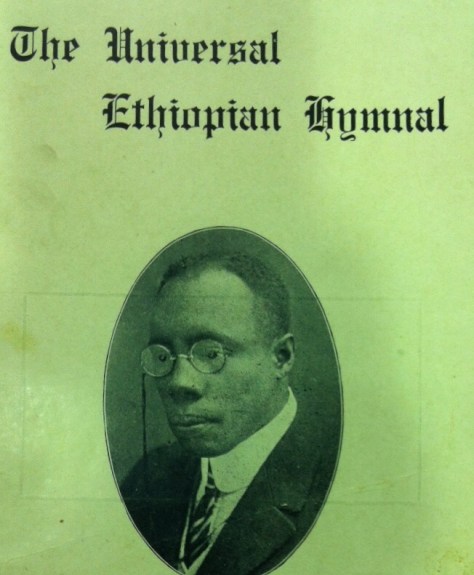
Ford’s contributions to the UNIA, however, were not limited to musical matters. He and E.L. Gaines wrote the handbook of rules and regulation for the African Legion (which was modeled after the Zionist Jewish Legion) and developed guidelines for the Black Cross Nurses. He served on committees, spoke at rallies, and was elected one of the delegates representing the 35,000 members of the New York chapter to the “First International Convention of Negro Peoples of the World,” held in 1920 at Madison Square Garden. There the governing body adopted the red, black, and green flag as its national ensign and Ford‟s song “Ethiopia” became the “Universal Ethiopian Anthem,” which the UNIA constitution required be sung at every gathering. During that same year, Ford published the Universal Ethiopian Hymnal. Ford was a proponent of replacing the disparaging term “Negro” with the term “Ethiopian,” as a general reference to people of African descent. This gave the line in Psalm 68 that “Ethiopia shall soon stretch out her hand to God,” a new significance and it became popular slogan of the organization. At the 1922 convention, Ford opened the proceedings for the session devoted to “The Politics and Future of the West Indian Negro,” and he represented the advocates of Judaism on a five-person ad hoc committee formed to investigate “the Future Religion of the Negro.” Following Garvey’s arrest in 1923, the UNIA loss much of its internal cohesion. Since Ford and his small band of followers were motivated by principals that were independent of Garvey’s charismatic appeal, they were repeatedly approached by government agents and asked to testify against Garvey at trial, which they all refused to do. However, in 1925, Ford brought separate law suits against Garvey and the UNIA for failing to pay him royalties from the sale of recordings and sheet music, and in 1926 the judge ruled in Ford’s favor. Yet, despite his personal and business differences with the organization, Ford remained active in the UNIA as a rabbi, giving invocations and benedictions.
Several black religious leaders experimented with various degrees of Judaism between the two world wars. Rabbi Ford formed intermittent partnerships with some of these leaders. He and Valentine started a short lived congregation called Beth B’nai Israel. Ford then worked with Mordecai Herman and the Moorish Zionist Temple, until they had an altercation over theological and financial issues. Finally, he established Beth B’nai Abraham in 1924. A Jewish scholar who visited the congregation described their services as “a mixture of Reform and Orthodox Judaism, but when they practice the old customs they are seriously orthodox” (Kobre, 25). Harlem chronicler JAMES VANDERZEE photographed the congregation with the Star of David and bold Hebrew lettering identifying their presence on 135th Street and showing Rabbi Ford standing in front of the synagogue with his arms around his string bass, and with members of his choir arrayed at his side, the women wearing the black dresses and long white head coverings that became their distinctive habit and the men donned in white turbans.

In 1928, Rabbi Ford created a business adjunct to the congregation called the B’nai Abraham Progressive Corporation. Reminiscent of many of Garvey’s ventures, this corporation issued 100 shares of stock and purchased two buildings from which it operated a religious and vocational school in one and an apartment house in the other. However, the resources to sustain this enterprise dwindled as the Depression became more pronounced, and the corporation went bankrupt in 1930. Once again it seemed that Ford’s dream of building a black community with cultural integrity, economic viability, and political virility was dashed, but out of the ashes of this disappointment he mustered the resolve to make a final attempt in Ethiopia. The Ethiopian government had been encouraging black people with skills and education to immigrate to Ethiopia for almost a decade, and Ford knew that there were over 40,000 indigenous black Jews already in Ethiopia who called themselves Beta Israel, but who were commonly referred to as Falasha. The announced coronation of Haile Selassie in 1930 as the first black ruler of an African nation in modern times raised the hopes of black people all over the world and led Ford to believe that the timing of his Ethiopian colony was providential.

Ford arrived in Ethiopia with a small musical contingent in time to perform during the coronation festivities. They then sustained themselves in Addis Abba by performing at local hotels and relying on assistance from supporters in the United Sates who were members of the Aurienoth Club, a civic group of black Jews and black nationalists, and members of the Commandment Keepers Congregation, led by RABBI W. A. MATTHEW, Ford‟s most loyal protégé. Mignon Innis arrived with a second delegation in 1931 to work as Ford’s private secretary. She soon became Ford’s wife, and they had two children in Ethiopia. Mrs. Ford established a school for boys and girls that specialized in English and music. Ford managed to secure 800 acres of land on which to begin his colony and approximately 100 individuals came to help him develop it. Unbeknownst to Ford, the U.S. State Department was monitoring their efforts with irrational alarm, dispatching reports with such headings as “American Negroes in Ethiopia—Inspiration Back of Their Coming Here—”Rabbi Josiah A. Ford,” and instituting discriminatory policies to curtail the travel of black citizens to Ethiopia. [Explain why briefly]

Ford had no intention of ever leaving Ethiopia, so he drew up a certificate of ordination (shmecha) for Rabbi Matthew that was sanctioned by the Ethiopian government with the hope that this document would give Matthew the necessary credentials to continue the work that Ford had begun in the United States. By 1935 the black Jewish experiment with Ethiopian Zionism was on the verge of collapse. Those who did not leave because of the hard agricultural work, joined the stampede of foreign nationals who sensed that war with Italy was imminent and defeat for Ethiopia certain. Ford, it was said, died of exhaustion and heartbreak in September, a few weeks before the Italian invasion.

Further Reading

The papers of Rabbi Ford are held largely in private collections; however, correspondence between Ford and Matthew is contained in the Rabbi Matthew Collection at the Schomburg Center for Research in Black Culture, along with other collections relating to Harlem’s black Jews. Detailed records of Ford‟s efforts in Ethiopia are available at the National Archives, State Department Records for Ethiopia.

King, Kenneth J. “Some Notes on Arnold J. Ford and New World Black Attitudes to Ethiopia,” in Black Apostles: Afro-American Clergy Confront the Twentieth Century, Randall Burkett and Richard Newman, eds. (1978).

Kobre, Sidney. “Rabbi Ford,” The Reflex 4, no. 1 (1929): 25-29. Scott, William R. “Rabbi Arnold Ford‟s Back-to-Ethiopia Movement: A Study of Black Emigration, 1930-1935,” Pan-African Journal 8, no. 2 (1975):191-201. and Richard Newman (1978) and William R. Scott. “Rabbi Arnold Ford‟s Back-to- Ethiopia Movement: A Study of Black Emigration, 1930-1935,” Pan-African Journal 8, no. 2 (1975): 191-201.

*This article was published by Rabbi Sholomo Levy in African American Lives (2004) and the African American National Biography (2008). Both volumes were edited by Henry Louis Gates Jr. and Evelyn Brooks Higginbotham and printed by Oxford University Press.

The World-Wide Influence of Ramayana

When Haile Selassie, the emperor of Ethiopia was gifted with a Ramayana by an Indian sannyasi, he smiled, and said they were all descendants of Lord Rama. He explained how the Ethiopians are called as Cushites, or coming down from Kusha, a son of Rama. The country is called Kushadwip, or the land of the son of Rama.

Ethiopians admit their ancestor as Kush, and they quote the Biblical story of Cush being a son of Ham (a phonetic misnomer of Ram). This only confirms to the widespread influence of Ramayana, even in a land that is 3000 miles away from the mainland of India.

Phonetic describes the way spoken words sound or are pronounced. When we closely examine the names of various places across the world, we can logically deduce how the culture of Ramayana must have influenced these lands, even thousands of years ago. Egypt derives its name from Ajpati, a name of one of Rama’s forefathers. Even the various legends in Egypt contain references to Dasharatha, the father of Rama, and thus even five thousand kilometres away, Ramayana had an influence.

The traces of Vedic age can be seen even today. Iranians have the culture of reverence to fire, an essential sacrificial tool in Vedic process. Armenia has an ancient structure, called the ‘temple of the little blue boy’-referring to Krishna. A French historian even claimed that the original Armenians were worshippers of Radha and Krishna.

This is explained in the Vedic scriptures: Parashuram was a great warrior who destroyed warrior class many times. As a result many kings ran to faraway lands and settled there. Over a period of time, due to the far distance from the main land of India, the culture of Rama and Krishna worship deteriorated.

Nearer home, in the South East Asian regions, Ramayana’s influence can be seen even today. Thailand’s national epic is called ‘Ramakien’– glory of Rama. Until the late 18th century, the capital of Thailand was Ayutthaya, derived from Ayodhya- the capital of Lord Rama. Most of the kings of Thailand are called as Rama-I or Rama-II and so on.

When Lord Rama shot an arrow at demon Maricha and disposed him off to the middle of an ocean, he settled in an island there. That place was called Mauricha or later evolved as Mauritius.

These instances prove that story of Ramayana is not simply a story that belongs to India; this is one of the most powerful stories in the history of the world.

Just as Bible has played a pivotal role in shaping the history of the Western world- you can read novels, appreciate art and history, and you will find some Biblical references there- similarly Ramayana has shaped all of Asian civilization. China, Japan and Korea have their own version of Ramayana story telling. Indonesia- the world’s largest Muslim country- even today has a popular puppet show on Ramayana.

Japan created an animated Ramayana made for the Japanese market by the Japanese; they too love to narrate the Ramayana. Over three hundred different versions- from South Indian to Urdu- Ramayana has captured the imagination of the people all over Asia for millennia.

In recent times, lands outside of Asia-like Africa and Europe- have revealed Ramayana’s influence. The Warner bros in US made a movie, ‘A little Princess’; the heart of the movie is the rendition of Ramayana by a young girl Sara.

The Ramayana story thus has a universal appeal. And that’s because it has all the ingredients of a good story: there is a hero, the princess, the damsel in distress. Adventure, romance, action, it’s all there. Yet, there is something more in Ramayana. It is the ‘adi-kavya’– the first poem. And the poetic masterpiece of Ramayana is known to humans for thousands of years.

Unfortunately modern scholars declare Ramayana to be a fiction; in most book stores, Ramayana is classified as ‘mythology’. However we need to remember that Ramayana is not a fairy tale born out of the fertile brains of some creative writers. Ramayana is a product of divine inspiration, revealed in the heart of a devotee by the Lord himself.

Even when Lord Krishna was personally present on this planet-5000 years ago- Ramayana was well known. That’s the reason the speaker of Srimad Bhagavatam, Srila Sukadeva Goswami devotes only two chapters to the Ramayana. The epic was sung in the courts of kings even those days.

*Article written by Vraja Bihari Das*

“Let us tell all of our children, throughout the world, this ancient story of Lord Rama, whose life teaches diligence and justice.” – Haile Selassie I, Speech on the Hindu Epic at Delhi University, May 20, 1956.

“Stories of Rama’s courage and devotion, sagacity and resourcefulness, filial obedience and most of all his unswerving devotion to God, are recorded in the scriptures of India.” – Haile Selassie I, Speech on the Hindu Epic at Delhi University, May 20, 1956.

“In providing us with the great epic of Rama, the Hindu has enshrined for us the rarest gems of moral and religious teaching in such form that, when touched, its emotional appeal rings out like a diamond struck upon a bell.” – Haile Selassie I, Speech on the Hindu Epic at Delhi University, May 20, 1956.

Jai Rastafari! Jah Krishnafari!!

Jai RamaChrista! Jah RastaKrishna!!

Thanks for visiting my blog! I hope you got lots of VALUE from this post! Questions or Comments always welcome!! Thank you!

~Sakshi Zion

Ps. Get Access Now to my FREE Ebook! How I use the Law of Attraction to travel the world and live my dreams!! Or Click Here to learn how you can make money with a blog, just like this. Thanks for visiting my Blog!